Rockwell Hardness Testing
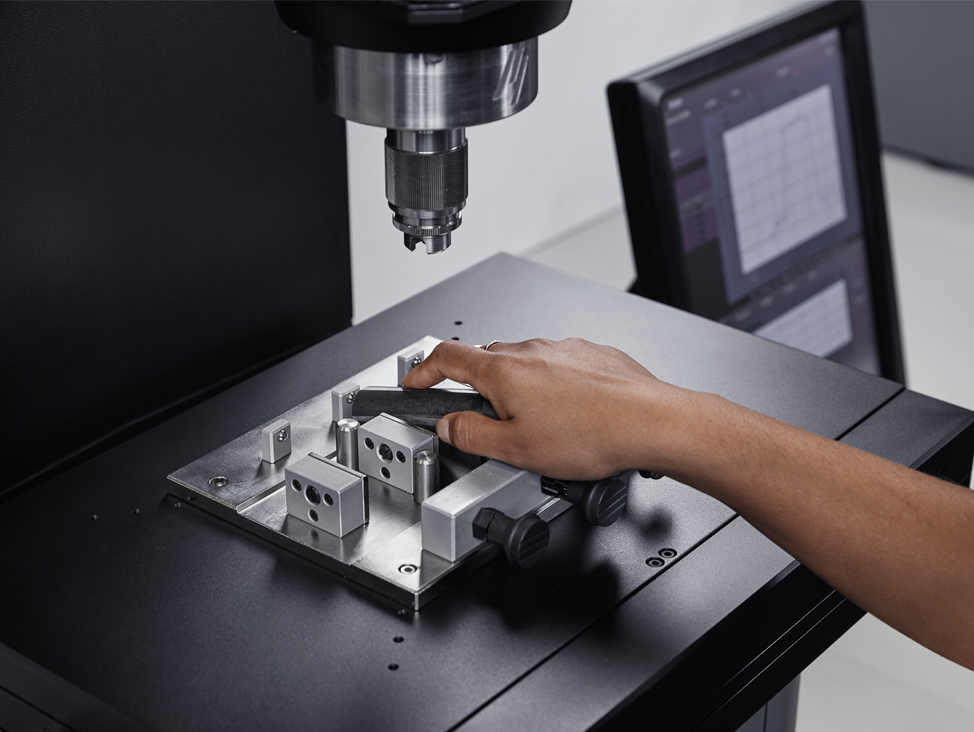
The Rockwell hardness test is a quick, reliable and easy to use method for quality assurance, making it ideal for both lab and production environments. Here we explain the fundamentals of the Rockwell test and provides practical information on its application and interpretation.

The Rockwell hardness test at a glance:
- Generally used for larger samples
- No optical readout
- Fast and easy to use
- Standards: ASTM E18, ISO 6508 and JIS Z 2245
Definition of the Rockwell hardness test
The Rockwell hardness test is often used as a ‘quick test’ on the production floor or in the laboratory, mainly for metallic materials. However, it can also be used for more advanced tests, such as the Jominy test (End Quench Test). Due to the relatively high loads used, application of the Rockwell hardness test is generally limited to larger sample geometries.
The Rockwell test calculation
The Rockwell hardness test calculation (HR) is made by measuring the depth of an indentation made with a diamond or tungsten carbide ball.
HR = E - e
E: is a constant of 100 (diamond) or 130 (ball) units
e: is the penetration depth in units of 0.002 mm (Regular) or 0.001 mm (Superficial scales)
Indenters
The Rockwell hardness test utilizes 1 of 5 different indenters:
- Diamond cone
- Tungsten ball in sizes 1/16", 1/8", 1/4", or 1/2"
Main loads
As with any hardness scale, Rockwell testing follows the principle that higher test loads reduce the influence of surface imperfections, roughness, and material inhomogeneities on the measurement result. Consequently, the Rockwell scales can be divided into regular scales, which use higher test loads and are generally preferred whenever possible, and superficial scales, which use lower loads and are particularly suitable for thin materials such as coatings, sheet metal, and other applications where indentation depth must be minimized.
- Superficial scales: 15 kgf, 30 kgf and 45 kgf,
- Regular scales: 60 kgf, 100 kgf and 150 kgf
In total, this gives 30 different Rockwell scales. Each one is characterized by a different combination of indenter type and main load, and is suitable for a particular material or application (for example, HRA, HRB, HRC, HR30N).
Prepare for a Rockwell hardness test
Specimen
Before performing a Rockwell hardness test, the test surface must be sufficiently prepared. The required surface finish depends on the
test scale and load being used. Since Rockwell testing is considered a macro-hardness method, utilizing test forces above 1 kgf. As a
result, a ground surface is generally sufficient, and for some applications, little or no surface preparation may be required.
The specimen must be well-supported during testing. Ensure that the back surface is flat, clean, and free from oxides, dirt, or
contaminants. Any movement, flexing, or instability of the specimen during testing can lead to inaccurate results, typically causing
hardness values to appear lower than the actual material hardness.
Equipment
To ensure reliable and traceable results, the hardness tester should undergo direct verification and calibration at least annually by an
accredited calibration laboratory. Between direct calibrations, operators are encouraged to perform regular indirect verifications using certified reference test blocks with known hardness values.
Because the Rockwell method measures indentation depth, the condition of the support system is critical. The test anvil should be flat, free from indentations, damage, and contamination, and should be free from grease or debris. Similarly, the anvil seat and spindle
interface must be kept clean.
For C-frame testers with a movable spindle, always keep the dust protector in place to prevent dirt, oxide particles, and other
contaminants from accumulating on the spindle. Clean spindles only with light machine oil and wipe away any excess oil after cleaning.
Environment
Like all hardness testing methods, Rockwell testing is sensitive to shock and vibration. The instrument should be installed on a stable
and rigid surface, and testing should not be performed while the machine is exposed to significant vibration from nearby equipment or
other external sources.
ISO and ASTM standards specify an operating temperature between 10 °C and 35 °C.
Operator
The operator is responsible for ensuring that the specimen is correctly positioned and remains stable throughout the test cycle.
Indentations should be placed sufficiently far apart to avoid interference from material deformation caused by previous tests.
As a general guideline, the distance between the centers of two adjacent indentations, or between the center of an indentation and the edge of the test piece, should be at least 5 mm. For specific applications, always consult the relevant Rockwell testing standard to confirm the required spacing and testing conditions.
The Rockwell Method
The Rockwell hardness test is defined in ASTM E18, ISO 6508, and JIS Z 2245. While there are minor differences between these standards, the core testing principles are largely aligned.
- Use the correct indenter and test force according to the selected Rockwell scale (see below table).
- Preliminary force application time: <2 seconds
- Total test force application time : 2-6 seconds
- Sample thickness:
- ASTM E18: At least 10 times the indentation depth for both indenters
- ISO 6508 - Diamond indenter: At least 10 times the indentation depth.
- ISO 6508 - Tungsten carbide indenter: At least 15 times the indentation depth.
Jominy testing
The Jominy test (End Quench Test) is a standardized test procedure used to determine the hardenability of steel, and it can be performed using any Vickers micro hardness tester.
- The procedure is described in the following standards: ASTM A255 / ISO 642 / DIN 50191 / BS 4437
The Jominy test involves heating a cylindrical steel test piece to an austenitizing temperature (~980°–1010°C) and quenching (cooling) from one end, with a controlled and standardized jet of water. After quenching, the hardness is measured at intervals taken from the quenched end. The test method used is either HRC or HV30.
The hardness variation along the test surface is a result of microstructural variation that arises as the cooling rate decreases with the distance from the quenched end. The harder the material at a given distance from the end, the higher the hardenability of the steel.
Both the Vickers and the Rockwell hardness tests are often used for Jominy testing. When selecting which to use, pay attention to the relevant standards, as well as the usual criteria when choosing between different types of hardness test.

Overview of the Rockwell hardness scales and their typical applications
Regular test methods
| Test Method | Load | Indenter Type | Application |
| A | 60 kgf | Diamond cone | Cemented carbides, thin steel and shallow case-hardened steel |
| B | 100 kgf | 1/16"" WC Ball | Copper alloys, soft steel, aluminium alloys, malleable iron etc. |
| C | 150 kgf | Diamond cone | Steel, hard cast irons, pearlitic malleable iron, titanium, deep cased hardened steel |
| D | 100 kgf | Diamond cone | Thin steel and medium case-hardened steel and pearlitic malleable iron |
| E | 100 kgf | 1/8"" WC Ball | Cast iron, aluminium and magnesium alloys, bearing metal |
| F | 60 kgf | 1/16"" WC Ball | Annealed copper alloys, thin soft sheet metals |
| G | 150 kgf | 1/16"" WC Ball | Phosphor bronze, beryllium copper, malleable irons |
| H | 60 kgf | 1/8"" WC | Aluminium, zinc, lead |
| K | 150 kgf | 1/8"" WC Ball | Bearing metals and other very soft or thin materials including plastics |
| L | 60 kgf | 1/4"" WC Ball | Bearing metals and other very soft or thin materials including plastics |
| M | 100 kgf | 1/4"" WC Ball | Bearing metals and other very soft or thin materials including plastics |
| P | 150 kgf | 1/4"" WC Ball | Bearing metals and other very soft or thin materials including plastics |
| R | 60 kgf | 1/2"" WC Ball | Bearing metals and other very soft or thin materials including plastics |
| S | 100 kgf | 1/2"" WC Ball | Bearing metals and other very soft or thin materials including plastics |
| V | 150 kgf | 1/2"" WC Ball | Bearing metals and other very soft or thin materials including plastics |
Superficial test methods
| Test Method | Load | Indenter Type | Application |
| N | 15 kgf 30 kgf 45 kgf |
Diamond cone | Rockwell superficial scales use lower loads than a regular Rockwell test and are used to test materials too thin or small for the regular scales or outside the regular ranges. Generally, diamond indenters are used for hard materials while Ball indenters are used on soft materials |
| T | 15 kgf 30 kgf 45 kgf |
1/16"" WC Ball | Rockwell superficial scales use lower loads than a regular Rockwell test and are used to test materials too thin or small for the regular scales or outside the regular ranges. Generally, diamond indenters are used for hard materials while Ball indenters are used on soft materials |
| W | 15 kgf 30 kgf 45 kgf |
1/8"" WC Ball | Rockwell superficial scales use lower loads than a regular Rockwell test and are used to test materials too thin or small for the regular scales or outside the regular ranges. Generally, diamond indenters are used for hard materials while Ball indenters are used on soft materials |
| X | 15 kgf 30 kgf 45 kgf |
1/4"" WC Ball | Rockwell superficial scales use lower loads than a regular Rockwell test and are used to test materials too thin or small for the regular scales or outside the regular ranges. Generally, diamond indenters are used for hard materials while Ball indenters are used on soft materials |
| Y | 15 kgf 30 kgf 45 kgf |
1/2"" WC Ball | Rockwell superficial scales use lower loads than a regular Rockwell test and are used to test materials too thin or small for the regular scales or outside the regular ranges. Generally, diamond indenters are used for hard materials while Ball indenters are used on soft materials |
ISO 6508 and ASTM E18 = A B C D E F G H K N T
ASTM E18 = L M P R S V W X Y
Download our brochure covering our Rockwell hardness testers
Downloads & Webinars about Hardness Testing
Whether you're just starting with hardness testing or are an experienced professional, this curated selection of resources is here to assist you in your work.
Take advantage of downloadable reference posters for easy use in your lab, and dive into expert-led webinars hosted by our application specialists to deepen your understanding of hardness testing techniques and methods.

Hardness testing posters
At present we have three different posters about hardness testing – all suitable for any lab. Download all posters now. Hardness Conversion Hardness Comparison Metallic materials
Hardness Conversion
Hardness Comparison
Metallic materials

Webinars about hardness testing
Upgrade your preparation skills and watch our recorded webinars with our application specialists about hardness testing.
Visual Analysis Inspection & Maintenance
Newest Generation of Hardness Testers
Sample Preparation and Parameters Influencing Results

Explore our Rockwell Hardness Testers for Labs and Production
Whether you need reliable hardness testing in the laboratory or efficient quality control on the production floor, our Rockwell hardness testers deliver the accuracy, repeatability, and ease of use you need.
Designed to support changing testing requirements, our solutions provide precise measurements across the Rockwell scales. Combined with intuitive software, certified calibration blocks, calibration services, and a comprehensive range of accessories, our hardness testing solutions help ensure consistent, traceable, and dependable results.