About Preparation for Transmission Electron Microscopy

Transmission electron microscopy (TEM) is a microscopy technique in which a beam of electrons is transmitted through an ultra-thin specimen, interacting with the specimen as it passes through it.
The ultra-thin specimen
The specimen typically consists of a 3.0 mm diameter disk of material that has been prepared so that a portion of it is thin enough to permit the electron beam to penetrate completely through it.
The maximum permissible thickness varies with the elements making up the sample (high atomic number elements are less transmissive) and the beam accelerating voltage (higher accelerating voltages enhance beam penetration), but it is typically in the range of one hundred to several hundred nanometers.
Specimens are thinned by a variety of methods including:
- Mechanical cutting and grinding (used in the preliminary steps of sample preparation)
- Electrolytic polishing (commonly used for final thinning of metals)
- Ion milling (used with both metals and insulating materials)
It is crucial that any damaged layer introduced during preliminary mechanical preparation is fully removed during subsequent electropolishing or ion milling.
Final thinning is continued until a hole first forms near the center of the disk; then the electropolishing or ion milling processes are immediately halted. The thin tapered portions of material adjacent to the hole are frequently thin enough to be electron transparent.
If electropolishing or ion milling are continued too long, the thin electron transparent sections adjacent to the hole will be removed, and the remaining material may be too thick to be penetrated by the electron beam.


How to Prepare for Transmission Electron Microscopy

Mechanical Cutting and Polishing
The specimen has to be cut into a small piece and ground and/or polished down to a certain thickness, usually some hundreds of microns. The cutting process can be done using Struers’ cutting machines. Precision cutting machines such as Accutom-10/-100 or Secotom-15/-50 are recommended. Any Struers' grinding or polishing machine can be used; machines for single sample or manual preparation such as LaboSystem or Tegramin are recommended. The specimen can be ground and/or polished down to a certain thickness. Accessories such as AccuStop, or AccuStop-T with special TEM-preparation inserts, can also be used.

Electrolytic Polishing
Electrolytic polishing can be used for pre-thinning the specimen to the desired thickness, using LectroPol-5 or TenuPol-5 with a pre-thinning holder. The final preparation stage requires extremely precise and sensitive polishing, using an electrolytic polishing machine such as TenuPol-5. TenuPol-5 can be used to prepare a perforated specimen for transmission electron microscopy in just a few minutes using a sample with a diameter of 3.0 or 2.3 mm. TenuPol-5 is designed for automatic electrolytic thinning of specimens for examination in a transmission electron microscope. The basic material with a diameter of 12-21 mm is pre-thinned to a thickness of less than 0.5 mm in an area up to 10 mm in diameter, using a special specimen holder.
How to Prepare for Transmission Electron Microscopy
Electrolytes
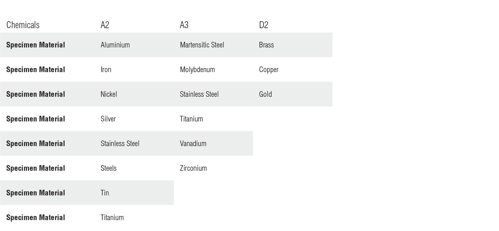
Struers supplies ready-prepared electrolytes for the most common materials such as:
Partner with the industry expert
No matter what you need, Struers has a solution that fits. Contact us today to start your own optimization process.